
How Enterprise Software Turns Complex BusinessOperations into a Competitive Advantage

Every Growing Business Reaches a Point Where Spreadsheets StopWorking
Growth is exciting—but it also introduces complexity.
Orders start flowing in from multiple channels. Sales teams need real-time visibility. Warehouses struggle tokeep inventory synchronized. Finance wants accurate collections and outstanding reports. Distributorsexpect faster responses. Management needs reliable dashboards instead of waiting days for reports.
Many organizations try to solve these problems by adding more people, more spreadsheets, or anothersoftware package. Unfortunately, this often creates disconnected systems that require manual work,duplicate data entry, and constant follow-ups.
The real challenge isn’t the volume of business.
It’s managing information seamlessly across the entire organization.
Enterprise Software Should Connect the Business, Not ComplicateIt
Modern enterprises rarely operate on a single software platform.
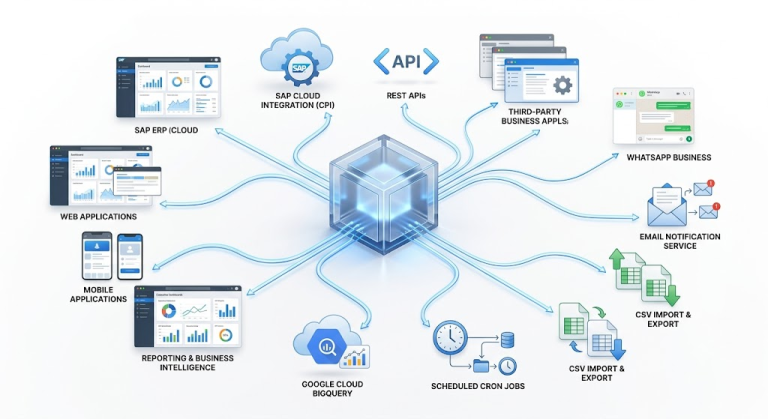
A typical organization may have an ERP, CRM, accounting software, warehouse management systems,mobile applications, vendor portals, customer portals, reporting tools, and several third-party platforms.Each system performs its own function well—but when they don’t communicate effectively, teams end upspending more time managing software than running the business.
The right enterprise application acts as the bridge between these systems.
It ensures that information moves automatically, accurately, and securely between departments withoutrequiring employees to perform repetitive manual tasks.
Solving Real Business Problems, Not Just Building Software
At Collective S Software, we focus on solving operational challenges rather than simply deliveringtechnology.
One of our enterprise engagements involved supporting one of India’s leading textile organizations inmodernizing several business workflows across sales, operations, warehouses, distributors, andmanagement reporting.
While every business is different, many of the challenges are surprisingly similar across industries:
- Sales teams require faster order processing.
- Operations need accurate inventory visibility.
- Warehouses must coordinate dispatches efficiently.
- Finance teams depend on timely outstanding and collection reports.
- Management requires real-time business insights.
- Business processes continue evolving as the company grows.
Instead of treating these as separate problems, we built an integrated ecosystem where multipleapplications work together as a single business platform.
Integration is Where Enterprise Projects Succeed—or Fail
Developing an application is only one part of the journey.
The real complexity lies in integrating it with existing business systems.
Enterprise software frequently needs to exchange information with ERP platforms, finance systems,inventory databases, logistics providers, customer portals, APIs, and other internal applications.
These integrations must be:
- Reliable
- Secure
- Highly available
- Scalable
- Easy to evolve as business processes change
When integration is done correctly, information flows automatically throughout the organization withoutmanual intervention.
Orders move faster.
Errors reduce dramatically.
Decision-making improves because everyone works from the same source of truth.
Built for Change
Business processes never remain static.
New approval workflows emerge.
Distribution models evolve.
Warehouse operations change.
Reporting requirements grow.
Management asks for new dashboards.
Customers expect better digital experiences.
Enterprise software must be designed with change in mind.
Instead of rebuilding systems every time a new requirement appears, flexible architecture allowsbusinesses to introduce new workflows, automate additional processes, and extend existing capabilitieswithout disrupting day-to-day operations.
This adaptability becomes one of the biggest long-term returns on investment.
Beyond Sales Orders
Although sales order management is often where digital transformation begins, the impact extends acrossthe entire organization.
Integrated enterprise applications can support:
- Customer and distributor management
- Sales order lifecycle
- Inventory visibility
- Warehouse coordination
- Dispatch planning
- Financial reporting
- Outstanding collections
- Employee workflows
- Vendor collaboration
- Approval processes
- Business analytics
- Executive dashboards
- Mobile applications for field teams
- Automated notifications and alerts
- Workflow automation across departments
Each improvement may appear small on its own, but together they create a faster, more efficientorganization.
Performance Matters at Enterprise Scale
Enterprise applications must continue performing even as the business grows.
Whether an organization processes hundreds of transactions daily or millions of records over time, theplatform should remain responsive, reliable, and maintainable.
This requires thoughtful system architecture, optimized databases, scalable APIs, efficient reportingmechanisms, and integration strategies that prevent bottlenecks before they occur.
Scalability isn’t just about handling more users.
It’s about ensuring the business never slows down because of technology.
Technology Should Empower People
One of the biggest misconceptions about enterprise software is that it’s only about automation.
In reality, the greatest benefit is enabling people to make better decisions.
When employees no longer spend hours searching for information, reconciling reports, or manuallyupdating systems, they can focus on activities that create value—serving customers, solving businessproblems, and improving operations.
Technology becomes an enabler rather than an obstacle.
Lessons That Apply Across Industries
Although our experience spans manufacturing, the principles remain consistent across healthcare, finance,logistics, retail, and other industries.
Organizations everywhere face similar questions:
- How do we eliminate manual work?
- How do we integrate multiple business systems?
- How do we provide management with accurate real-time information?
- How do we scale without increasing operational complexity?
- How do we adapt quickly when business requirements change?
The answer is rarely another standalone application.
It’s an integrated digital ecosystem designed around business processes.
The Collective S Approach
Every organization has its own way of working.
That is why we don’t begin with technology.
We begin by understanding the business.
We study existing workflows, identify operational bottlenecks, understand how different departmentsinteract, and design solutions that fit naturally into the organization’s day-to-day operations.
The result is software that employees actually use, management can trust, and businesses can continueexpanding without technology becoming a constraint.
Whether the objective is modernizing legacy applications, integrating enterprise platforms, automatingworkflows, building mobile applications, or creating a unified operational ecosystem, our goal remains thesame:
Build technology that makes business operations simpler, faster, and more scalable.
Looking to Modernize Your Enterprise Operations?
If your organization is struggling with disconnected systems, manual processes, reporting delays, orgrowing operational complexity, it may be time to rethink how your business applications work together.
At Collective S Software, we help organizations design and build custom enterprise solutions that integrateseamlessly with existing systems, automate business processes, and provide the visibility needed to makefaster, better decisions.
Because great software isn’t just about writing code.
It’s about helping businesses operate smarter.
Address
89, Sunrays Shopping Center, Kandivali (west), Mumbai, IndiaEmail Address
umesh@collective-sqa.csunderdevsites.infoMobile Number
India +91-9892881814Public Holidays Copyright © 2026 Collective S Software Pvt. Ltd. | All rights reserved. Terms & Conditions